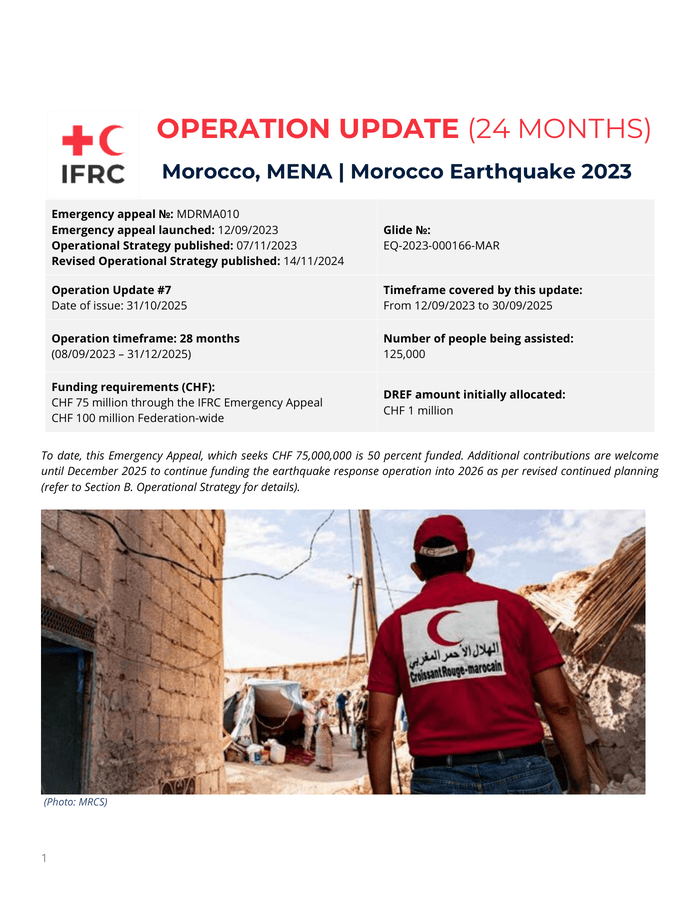
Morocco Earthquake 2023 Operation Update #7 (24 months) (MDRMA010)
**A. SITUATION ANALYSIS** **I. Description of the crisis** *Initial crisis* On 8 September 2023, Morocco was struck by a 6.8 magnitude earthquake, centered in the High Atlas Mountains, 71km southwest of Marrakesh1. Followed by a 4.9 magnitude aftershock, the earthquake caused extensive damage to bui
PDF Document
Download
**A. SITUATION ANALYSIS** **I. Description of the crisis** *Initial crisis* On 8 September 2023, Morocco was struck by a 6.8 magnitude earthquake, centered in the High Atlas Mountains, 71km southwest of Marrakesh1. Followed by a 4.9 magnitude aftershock, the earthquake caused extensive damage to buildings and critical infrastructure throughout the provinces of El-Haouz/Marrakesh, Chichaoua and Taroudant as well as Ouarzazate and Azilal. Remote villages near the epicentre in the Atlas Mountains have suffered substantial damage and emergency services faced difficulty reaching affected people due to damaged roads and challenging terrain. Authorities have reported some 3,000 human casualties, and some 6,000 people injured as well as almost 60,000 houses destroyed or damaged in urban, peri-urban and rural areas. Schools, health facilities and other public amenities have also suffered severe damage. Damage to houses and critical infrastructure was extensive in all affected areas, resulting in an urgent need for shelter and household essential support. For months, many people continued living in tent settlements close to their damaged homes, and others were crowded in communal ‘displacement’ sites or informal shelters which lack electricity, proper water and sanitation, security and privacy. Today, we see varying levels of completion of house reconstructions depending on the villages, but progress is noticeable everywhere. Water and sanitation facilities have been greatly damaged or destroyed in many communities, exacerbating the risk and spread of diseases stemming from untreated water sources, poor hygiene practices and open defecation. Communicable diseases, in particular, threaten people living in cramped tented settlements. The affected areas, as well as other regions in the country, face a measles epidemic since late 2023 with around 25,000 measles cases and 120 deaths2. Primary health care services have been disrupted in affected areas, posing a significant risk to people requiring services for chronic diseases and preventive care, including children and pregnant women. Medical, rehabilitation, and psychosocial services are also limited, especially for those in rural areas. At the same time, interaction with affected people has shown a necessity to provide mental health and psychosocial support services together with other forms of humanitarian assistance. The long-term impact on the mental health of affected communities resulting from the trauma of the earthquake is evident. Considerable damage to houses, buildings and infrastructure has also limited access to livelihoods in affected communities. Many people in remote areas rely on barter trade for survival and have found their resources destroyed or made inaccessible under the rubble of their damaged homes. Destruction of schools has also caused many children, especially girls, to temporarily stop their primary education, and for those who have returned to school, conditions were often very difficult or sometimes putting them at risk.