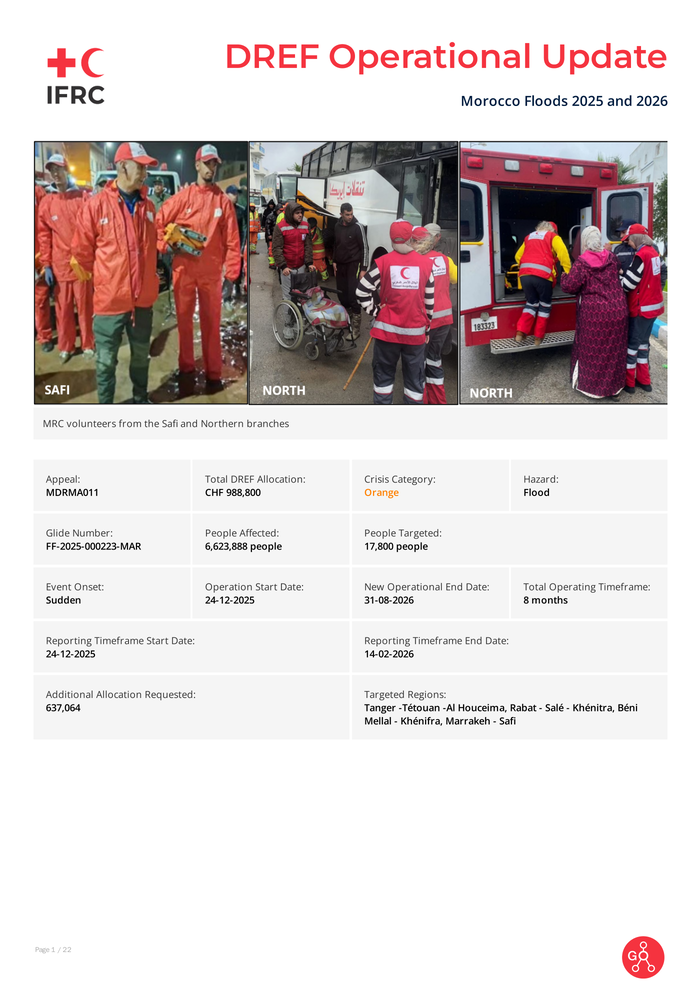
DREF Operational Update Morocco Floods 2025 and 2026 (MDRMA011)
Between mid-December 2025 and early February 2026, Morocco experienced two successive flood emergencies that exposed both acute urban flash-flood vulnerability and systemic hydrological stress across major river basins. (1) SAFI: What happened On 14 December 2025, highly concentrated, short-duration
PDF Document
Download
Between mid-December 2025 and early February 2026, Morocco experienced two successive flood emergencies that exposed both acute urban flash-flood vulnerability and systemic hydrological stress across major river basins. (1) SAFI: What happened On 14 December 2025, highly concentrated, short-duration rainfall triggered sudden urban flooding and flash floods in Safi Province. Intense precipitation—19 mm in one hour, 46 mm over 24 hours, and up to 60 mm within three hours—overwhelmed saturated and inadequate drainage systems, causing the overflow of Oued Chaaba and rapid inundation of low-lying, densely populated urban areas. Rainfall persisted for three days, with the most severe impacts recorded on 14–15 December. The event was rated 0.5 on the GDACS scale and resulted in 37 fatalities, an estimated 23 injuries, and significant damage to housing, livelihoods, and infrastructure. Where The flooding affected Safi Province, on Morocco’s Atlantic coast, with the most severe impacts in the Medina, particularly the Bab Chaaba and Sidi Boudheb neighbourhoods. These areas are characterized by very high urban density (up to 400 residents per hectare), older housing stock, and structural vulnerabilities, with an estimated population of 10,000 exposed in the most affected zones. When The floods began on 14 December 2025, with peak impacts occurring between 14 and 15 December, while rainfall continued intermittently for up to three days. Approximately 700 households (around 2,800 people) were affected, with around 300 homes partially or fully flooded, leading to loss of essential household items and temporary displacement. Although heavy rainfall subsided locally, ongoing winter conditions and national alerts for rain and snow elsewhere in Morocco continued to elevate risk and slow recovery efforts. (2) NORTH What happened In early February 2026, a second and significantly more extensive flood cycle unfolded across northern and central Morocco following exceptional and prolonged rainfall. Widespread flooding affected major river basins, driven by saturated catchments, rapidly rising river levels, and controlled dam releases. At Oued El Makhazine dam, water levels exceeded bank-full conditions, storage reached approximately 146.85% of normal operational capacity, cumulative releases surpassed 372 million m³, and peak flows reached around 560 m³/s during a critical 48-hour window. Red and orange meteorological alerts issued between 3–5 February forecast rainfall of up to 150 mm, followed by further warnings through 8 February of 30–70 mm of rain, thunderstorms, hail, snowfall in mountainous areas, and wind gusts up to 85 km/h, sustaining high flood risk and complicating response and recovery. Where Flooding affected the Loukkos, Sebou, and Martil/Tétouan river basins, inundating low-lying urban and rural areas across 11 provinces and prefectures, from Tétouan and Chefchaouen in the north to Casablanca and Rabat along the Atlantic corridor. Severe impacts were reported in Ksar El Kebir, which was described as largely deserted, alongside major disruptions to transport, electricity, water supply, and education systems across affected regions. When The flood cycle intensified in early February 2026, with evacuations escalating rapidly between 6–7 February, exceeding 150,000 people (approximately 2.33% of the population). Across affected areas, an estimated 6 million people were considered impacted. The highest evacuation figures were recorded in Larache (112,695), Kénitra (23,174), Sidi Kacem (14,049), and Sidi Slimane (4,361). Six fatalities were confirmed, including two children in Tétouan. Displaced populations were accommodated in temporary shelter centres, including school dormitories (notably lycée Oued Al Makhazine and lycée qualifiant Al Mohammedia), with additional shelter units deployed. While rainfall eased in some areas, ongoing disruptions to roads, rail services, electricity, drinking water supply, and continued school closures prolonged impacts and delayed recovery.